
Saartje: Novel dual sorbent carbon capture and utilization method
Published:
The increasing concentration of carbon dioxide (CO₂) in the atmosphere poses a major challenge, underscoring the urgent need for innovative carbon capture and utilization technologies that pave the way towards a circular carbon economy. This thesis presents a novel dual sorbent system that combines solid sorbent and liquid solvent techniques to capture and convert CO₂ into syngas. A valuable chemical product which can then be further processed into a variety of chemical products or used as a clean energy source. The primary goal of this research is to demonstrate the viability of this integrated system and identify the main cost drivers affecting its economic feasibility. The methodology involves experimental procedures for CO₂ adsorption, using an amine functionalized adsorbent, desorption using a carbonate solution, and subsequent electrochemical reduction to produce syngas. The performance of the system was evaluated through experiments validating the working principle of each step in this novel route. A Techno-Economic Analysis was conducted to assess its economic viability.
Key findings indicate that the integrated system has significant potential for efficient CO₂ capture and conversion. Experimental results confirm the functionality of each component within the novel system, validating the operational effectiveness of the integrated approach. Electrochemical reduction of bicarbonate solutions successfully produced syngas. Cost analysis of the capture system revealed the significant influence of the contactor cost on the total capture cost. When coupled to the bicarbonate electrolyser two main products are obtained; CO and H₂ with ratios depending on operating conditions. To assess the cost-effectiveness of this total system, three scenarios were evaluated within a single framework: the first scenario considers carbon monoxide (CO) as the sole output; the second encompasses both CO and hydrogen (H₂) as products in the ratio as is; and the third adjusts the syngas composition to achieve a CO to H₂ ratio of 2:1 (syngas), which can directly be used in Fischer Tropsch synthesis to obtain hydrocarbons as gasoline and diesel. The cost analysis showed that, especially when hydrogen is also included as a product, this new method could compete with conventional subsequent routes.
Future research should focus on developing an optimized system design especically designed for the dual sorbent system, exploring the full integration of capture and conversion processes, and conducting location-specific analyses.
This project was a collaboration with the group of Ruud Kortlever.
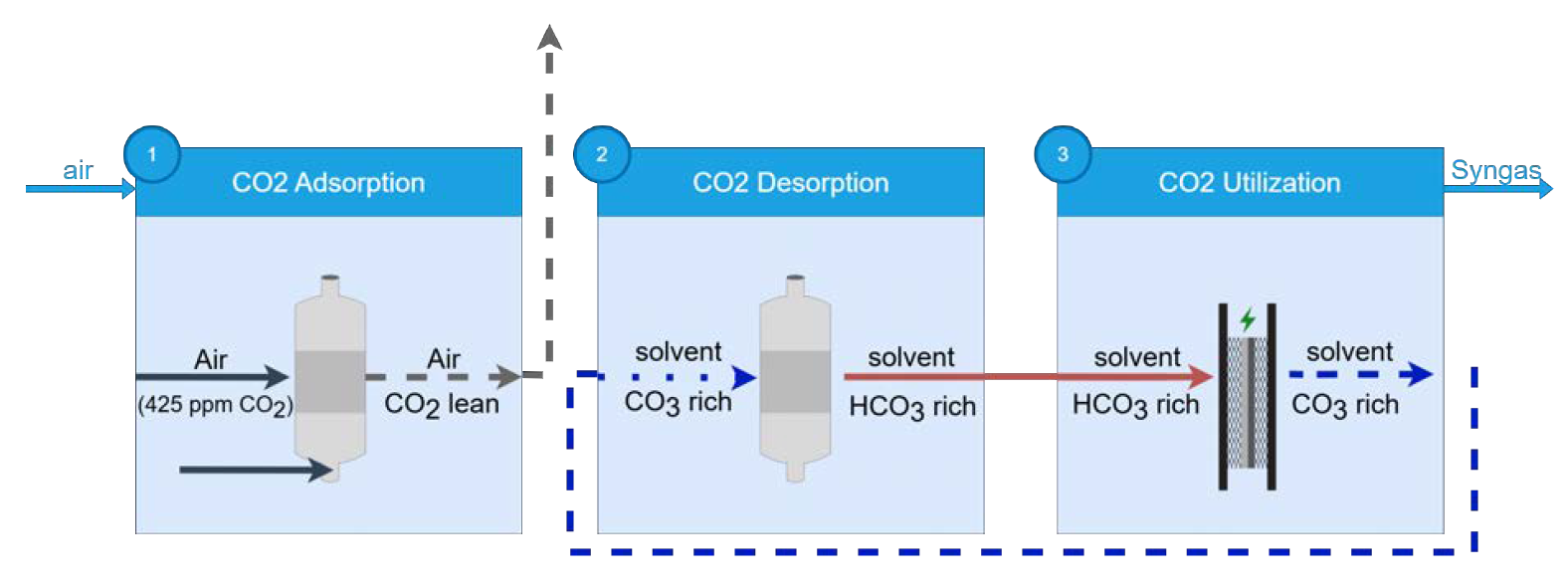
The three steps involved in the proposed Dual Sorbent Direct Air Capture and Utilization system.