
Ruben: Enabling scalable Direct Air Capture with concentrated solar power
Published:
This thesis explored the integration of solid sorbent direct air capture (DAC) with two types of concentrated solar power, to create a renewable and scalable approach for carbon dioxide removal. Parabolic trough collector (PTC) and solar power tower (SPT) systems are modelled dynamically on an hourly basis, combined with the energy requirement and performance of the DAC model. Because system output is highly sensitive to climatic conditions, two high-irradiance locations in Almeria, Spain and Alice Springs, Australia are evaluated using typical meteorological year data.
The results show that SPT outperforms PTC in achieving the lowest levelised cost of CO₂ removal (LCOD), primarily due to its lower thermal energy storage costs. The configuration optimised for LCOD involves significant oversizing of the solar field and storage, far larger than the configuration optimised for cost of heat. This increases the capacity, and utilises the CAPEX-intensive DAC installation to a greater extent. These DAC costs are the main cost driver accounting for 68% of the cost for a conservative scenario. A sensitivity analysis reveals that lowering the DAC costs is found not to change the optimal configuration significantly, allowing the LCOD of a lower CAPEX scenario to be determined accurately from the results.
The weather conditions in Alice Springs result in a reduction of the LCOD by up to 27% compared to Almeria, due to higher and more constant solar availability combined with lower humidities. While PTC systems have higher LCOD, they require significantly less land. Overall, the combination of CSP and DAC is technically viable and it offers a scalable, land efficient alternative to nature based carbon dioxide removal methods.
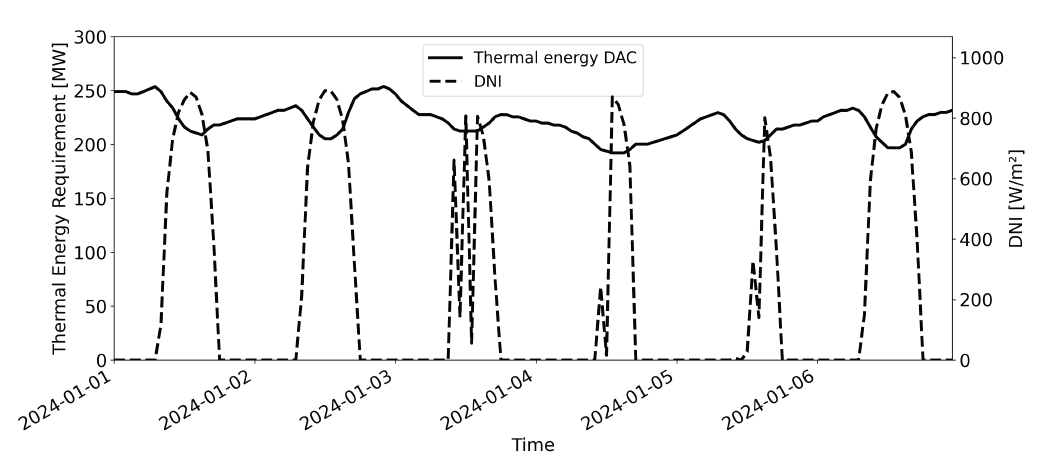
The DNI and thermal energy requirement of the DAC system are plotted for the first six days of the typical meteorological year for Almeria. The peaks of DNI align very well with the troughs of the energy requirement. This indicates that the CSP system delivers most heat exactly when DAC requires the least energy per ton CO₂. This effect explains the lower capacity found using average yearly values compared to hourly values.