Amirreza: Understanding and controlling direct air capture under dynamic conditions
Published:
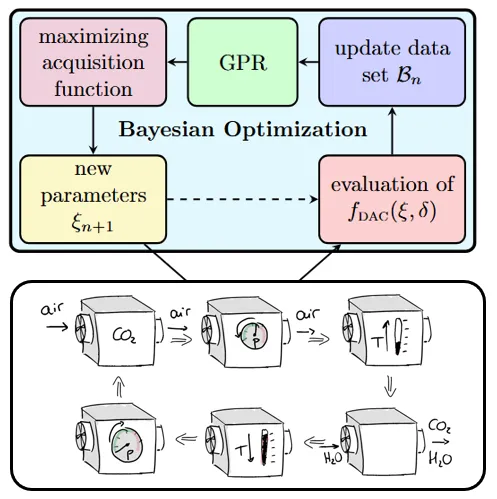
To achieve the Paris Agreement’s 1.5 °C target, it is essential to reduce carbon dioxide emissions to net zero and beyond by removing CO₂ from the atmosphere. Direct Air Capture (DAC) is an emerging technology that captures CO₂ directly from the air, offering negative carbon emissions. Enhancing and scaling up DAC is vital for reaching the net-zero carbon emissions goal by 2050. DAC operations depend on green energy sources (such as solar and wind), which are intermittently available, and are highly sensitive to weather conditions like temperature and humidity. This variability results in fluctuating process economics, necessitating advanced control mechanisms, which are currently lacking in the literature. Our research is aimed at modelling and controlling DAC systems under varying atmospheric conditions and intermittent power supply. We develop a dynamic process model to simulate DAC operations under these fluctuating conditions. Using this model, we analyse and manage the system’s sensitivity to changes. Our research develops control strategies to optimize DAC efficiency and economic performance in real-world conditions, reducing capture costs and aiding in the large-scale adoption of DAC technology.